For Grace Bulmer Bowers
From narrow provinces
of fish and bread and tea,
home of the long tides
where the bay leaves the sea
twice a day and takes
the herrings long rides,
where if the river
enters or retreats
in a wall of brown foam
depends on if it meets
the bay coming in,
the bay not at home;
where, silted red,
sometimes the sun sets
facing a red sea,
and others, veins the flats'
lavender, rich mud
in burning rivulets;
on red, gravelly roads,
down rows of sugar maples,
past clapboard farmhouses
and neat, clapboard churches,
bleached, ridged as clamshells,
past twin silver birches,
through late afternoon
a bus journeys west,
the windshield flashing pink,
pink glancing off of metal,
brushing the dented flank
of blue, beat-up enamel;
down hollows, up rises,
and waits, patient, while
a lone traveller gives
kisses and embraces
to seven relatives
and a collie supervises.
Goodbye to the elms,
to the farm, to the dog.
The bus starts. The light
grows richer; the fog,
shifting, salty, thin,
comes closing in.
Its cold, round crystals
form and slide and settle
in the white hens' feathers,
in gray glazed cabbages,
on the cabbage roses
and lupins like apostles;
the sweet peas cling
to their wet white string
on the whitewashed fences;
bumblebees creep
inside the foxgloves,
and evening commences.
One stop at Bass River.
Then the Economies
Lower, Middle, Upper;
Five Islands, Five Houses,
where a woman shakes a tablecloth
out after supper.
A pale flickering. Gone.
The Tantramar marshes
and the smell of salt hay.
An iron bridge trembles
and a loose plank rattles
but doesn't give way.
On the left, a red light
swims through the dark:
a ship's port lantern.
Two rubber boots show,
illuminated, solemn.
A dog gives one bark.
A woman climbs in
with two market bags,
brisk, freckled, elderly.
"A grand night. Yes, sir,
all the way to Boston."
She regards us amicably.
Moonlight as we enter
the New Brunswick woods,
hairy, scratchy, splintery;
moonlight and mist
caught in them like lamb's wool
on bushes in a pasture.
The passengers lie back.
Snores. Some long sighs.
A dreamy divagation
begins in the night,
a gentle, auditory,
slow hallucination. . . .
In the creakings and noises,
an old conversation
--not concerning us,
but recognizable, somewhere,
back in the bus:
Grandparents' voices
uninterruptedly
talking, in Eternity:
names being mentioned,
things cleared up finally;
what he said, what she said,
who got pensioned;
deaths, deaths and sicknesses;
the year he remarried;
the year (something) happened.
She died in childbirth.
That was the son lost
when the schooner foundered.
He took to drink. Yes.
She went to the bad.
When Amos began to pray
even in the store and
finally the family had
to put him away.
"Yes . . ." that peculiar
affirmative. "Yes . . ."
A sharp, indrawn breath,
half groan, half acceptance,
that means "Life's like that.
We know it (also death)."
Talking the way they talked
in the old featherbed,
peacefully, on and on,
dim lamplight in the hall,
down in the kitchen, the dog
tucked in her shawl.
Now, it's all right now
even to fall asleep
just as on all those nights.
--Suddenly the bus driver
stops with a jolt,
turns off his lights.
A moose has come out of
the impenetrable wood
and stands there, looms, rather,
in the middle of the road.
It approaches; it sniffs at
the bus's hot hood.
Towering, antlerless,
high as a church,
homely as a house
(or, safe as houses).
A man's voice assures us
"Perfectly harmless. . . ."
Some of the passengers
exclaim in whispers,
childishly, softly,
"Sure are big creatures."
"It's awful plain."
"Look! It's a she!"
Taking her time,
she looks the bus over,
grand, otherworldly.
Why, why do we feel
(we all feel) this sweet
sensation of joy?
"Curious creatures,"
says our quiet driver,
rolling his r's.
"Look at that, would you."
Then he shifts gears.
For a moment longer,
by craning backward,
the moose can be seen
on the moonlit macadam;
then there's a dim
smell of moose, an acrid
smell of gasoline.
From The Complete Poems 1927-1979 by Elizabeth Bishop, published by Farrar, Straus & Giroux, Inc. Copyright © 1979, 1983 by Alice Helen Methfessel. See Poets.org
Monday, December 24, 2007


Thursday, December 20, 2007
Old Maids by Sandra Cisneros
My cousins and I,
we don't marry.
We're too old
by Mexican standards.
And the relatives
have long suspected
we can't anymore
in white.
My cousins and I,
we're all old
maids at thirty.
Who won't dress children,
and never saints--
though we undress them.
The aunts,
they've given up on us.
No longer nudge--You're next.
Instead--
What happened in your childhood?
What left you all mean teens?
Who hurt you, honey?
But we've studied
marriages too long--
Aunt Ariadne,
Tia Vashti,
Comadre Penelope,
querida Malintzin,
Senora Pumpkin Shell--
lessons that served us well.
Saturday, December 01, 2007
Coal by Audre Lorde
I
is the total black, being spoken
from the earth's inside.
There are many kinds of open
how a diamond comes into a knot of flame
how sound comes into a word, colored
by who pays what for speaking.
Some words are open like a diamond
on glass windows
singing out within the crash of sun
Then there are words like stapled wagers
in a perforated book - buy and sign and tear apart -
and come whatever wills all chances
the stub remains
an ill-pulled tooth with a ragged edge.
Some words live in my throat
breeding like adders. Other know sun
seeking like gypsies over my tongue
to explode through my lips
like young sparrows bursting from shell.
Some words
bedevil me
Love is word, another kind of open.
As the diamond comes into a knot of flame
I am Black because I come from the earth's inside
Now take my word for jewel in the open light.
Saturday, November 03, 2007
On A Night of The Full Moon by Audre Lorde
I
Out of my flesh that hungers
and my mouth that knows
comes the shape I am seeking
for reason.
The curve of your waiting body
fits my waiting hand
your breasts warm as sunlight
your lips quick as young birds
between your thighs the sweet
sharp taste of limes
Thus I hold you
frank in my heart's eye
in my skin's knowing
as my fingers conceive your flesh
I feel your stomach
moving against mine
Before the moon wanes again
we shall come together.
II
And I would be the moon
spoken over your beckoning flesh
breaking against reservations
beaching thought
my hands at your high tide
over and under inside you
and the passing of hungers
attended, forgotten.
Darkly risen
the moon speaks
my eyes
judging your roundness
delightful.
Tuesday, October 30, 2007
"The Raven" by Edgar Allan Poe
[First published in 1845]
Once upon a midnight dreary, while I pondered weak and weary,
Over many a quaint and curious volume of forgotten lore,
While I nodded, nearly napping, suddenly there came a tapping,
As of some one gently rapping, rapping at my chamber door.
`'Tis some visitor,' I muttered, `tapping at my chamber door -
Only this, and nothing more.'
Ah, distinctly I remember it was in the bleak December,
And each separate dying ember wrought its ghost upon the floor.
Eagerly I wished the morrow; - vainly I had sought to borrow
From my books surcease of sorrow - sorrow for the lost Lenore -
For the rare and radiant maiden whom the angels named Lenore -
Nameless here for evermore.
And the silken sad uncertain rustling of each purple curtain
Thrilled me - filled me with fantastic terrors never felt before;
So that now, to still the beating of my heart, I stood repeating
`'Tis some visitor entreating entrance at my chamber door -
Some late visitor entreating entrance at my chamber door; -
This it is, and nothing more,'
Presently my soul grew stronger; hesitating then no longer,
`Sir,' said I, `or Madam, truly your forgiveness I implore;
But the fact is I was napping, and so gently you came rapping,
And so faintly you came tapping, tapping at my chamber door,
That I scarce was sure I heard you' - here I opened wide the door; -
Darkness there, and nothing more.
Deep into that darkness peering, long I stood there wondering, fearing,
Doubting, dreaming dreams no mortal ever dared to dream before
But the silence was unbroken, and the darkness gave no token,
And the only word there spoken was the whispered word, `Lenore!'
This I whispered, and an echo murmured back the word, `Lenore!'
Merely this and nothing more.
Back into the chamber turning, all my soul within me burning,
Soon again I heard a tapping somewhat louder than before.
`Surely,' said I, `surely that is something at my window lattice;
Let me see then, what thereat is, and this mystery explore -
Let my heart be still a moment and this mystery explore; -
'Tis the wind and nothing more!'
Open here I flung the shutter, when, with many a flirt and flutter,
In there stepped a stately raven of the saintly days of yore.
Not the least obeisance made he; not a minute stopped or stayed he;
But, with mien of lord or lady, perched above my chamber door -
Perched upon a bust of Pallas just above my chamber door -
Perched, and sat, and nothing more.
Then this ebony bird beguiling my sad fancy into smiling,
By the grave and stern decorum of the countenance it wore,
`Though thy crest be shorn and shaven, thou,' I said, `art sure no craven.
Ghastly grim and ancient raven wandering from the nightly shore -
Tell me what thy lordly name is on the Night's Plutonian shore!'
Quoth the raven, `Nevermore.'
Much I marvelled this ungainly fowl to hear discourse so plainly,
Though its answer little meaning - little relevancy bore;
For we cannot help agreeing that no living human being
Ever yet was blessed with seeing bird above his chamber door -
Bird or beast above the sculptured bust above his chamber door,
With such name as `Nevermore.'
But the raven, sitting lonely on the placid bust, spoke only,
That one word, as if his soul in that one word he did outpour.
Nothing further then he uttered - not a feather then he fluttered -
Till I scarcely more than muttered `Other friends have flown before -
On the morrow he will leave me, as my hopes have flown before.'
Then the bird said, `Nevermore.'
Startled at the stillness broken by reply so aptly spoken,
`Doubtless,' said I, `what it utters is its only stock and store,
Caught from some unhappy master whom unmerciful disaster
Followed fast and followed faster till his songs one burden bore -
Till the dirges of his hope that melancholy burden bore
Of "Never-nevermore."'
But the raven still beguiling all my sad soul into smiling,
Straight I wheeled a cushioned seat in front of bird and bust and door;
Then, upon the velvet sinking, I betook myself to linking
Fancy unto fancy, thinking what this ominous bird of yore -
What this grim, ungainly, gaunt, and ominous bird of yore
Meant in croaking `Nevermore.'
This I sat engaged in guessing, but no syllable expressing
To the fowl whose fiery eyes now burned into my bosom's core;
This and more I sat divining, with my head at ease reclining
On the cushion's velvet lining that the lamp-light gloated o'er,
But whose velvet violet lining with the lamp-light gloating o'er,
She shall press, ah, nevermore!
Then, methought, the air grew denser, perfumed from an unseen censer
Swung by Seraphim whose foot-falls tinkled on the tufted floor.
`Wretch,' I cried, `thy God hath lent thee - by these angels he has sent thee
Respite - respite and nepenthe from thy memories of Lenore!
Quaff, oh quaff this kind nepenthe, and forget this lost Lenore!'
Quoth the raven, `Nevermore.'
`Prophet!' said I, `thing of evil! - prophet still, if bird or devil! -
Whether tempter sent, or whether tempest tossed thee here ashore,
Desolate yet all undaunted, on this desert land enchanted -
On this home by horror haunted - tell me truly, I implore -
Is there - is there balm in Gilead? - tell me - tell me, I implore!'
Quoth the raven, `Nevermore.'
`Prophet!' said I, `thing of evil! - prophet still, if bird or devil!
By that Heaven that bends above us - by that God we both adore -
Tell this soul with sorrow laden if, within the distant Aidenn,
It shall clasp a sainted maiden whom the angels named Lenore -
Clasp a rare and radiant maiden, whom the angels named Lenore?'
Quoth the raven, `Nevermore.'
`Be that word our sign of parting, bird or fiend!' I shrieked upstarting -
`Get thee back into the tempest and the Night's Plutonian shore!
Leave no black plume as a token of that lie thy soul hath spoken!
Leave my loneliness unbroken! - quit the bust above my door!
Take thy beak from out my heart, and take thy form from off my door!'
Quoth the raven, `Nevermore.'
And the raven, never flitting, still is sitting, still is sitting
On the pallid bust of Pallas just above my chamber door;
And his eyes have all the seeming of a demon's that is dreaming,
And the lamp-light o'er him streaming throws his shadow on the floor;
And my soul from out that shadow that lies floating on the floor
Shall be lifted - nevermore!
Saturday, September 15, 2007
Afterlife by Joan Larkin
I’m older than my father when he turned
bright gold and left his body with its used-up liver
in the Faulkner Hospital, Jamaica Plain. I don’t
believe in the afterlife, don’t know where he is
now his flesh has finished rotting from his long
bones in the Jewish Cemetery—he could be the only
convert under those rows and rows of headstones.
Once, washing dishes in a narrow kitchen
I heard him whistling behind me. My nape froze.
Nothing like this has happened since. But this morning
we were on a plane to Virginia together. I was 17,
pregnant and scared. Abortion was waiting,
my aunt’s guest bed soaked with blood, my mother
screaming—and he was saying Kids get into trouble—
I’m getting it now: this was forgiveness.
I think if he’d lived he’d have changed and grown
but what would he have made of my flood of words
after he’d said in a low voice as the plane
descended to Richmond in clean daylight
and the stewardess walked between the rows
in her neat skirt and tucked-in blouse
Don’t ever tell this to anyone.
From My Body: New and Selected Poems by Joan Larkin. Copyright © 2007 by Joan Larkin. Used by permission of Hanging Loose Press. On American Academy of Poets. ord
Friday, August 31, 2007
_The Dream Songs_, #4, John Berryman
Filling her compact & delicious body
with chicken páprika, she glanced at me
twice.
Fainting with interest, I hungered back
and only the fact of her husband & four other people
kept me from springing on her
or falling at her little feet and crying
'You are the hottest one for years of night
Henry's dazed eyes
have enjoyed, Brilliance.' I advanced upon
(despairing) my spumoni.--Sir Bones: is stuffed,
de world, wif feeding girls.
--Black hair, complexion Latin, jewelled eyes
downcast . . . The slob beside her feasts . . . What wonders is
she sitting on, over there?
The restaurant buzzes. She might as well be on Mars.
Where did it all go wrong? There ought to be a law against Henry.
--Mr. Bones: there is.
From The Dream Songs by John Berryman, published by Farrar, Straus & Giroux, Inc. Copyright © 1959, 1962, 1963, 1964, 1965, 1966, 1967, 1968, 1969 by John Berryman. Used with permission.
Tuesday, August 28, 2007
Moon and Earth, Alicia Ostriker
Of one substance, of one
Matter, they have cruelly
Broken apart. They never will touch
Each other again. The shining
Lovelier and younger
Turns away, a pitiful girl.
She is completely naked
And it hurts. The larger
Motherly one, breathlessly luminous
Emerald, and blue, and white
Traveling mists, suffers
Birth and death, birth
And death, and the shock
Of internal heat killed by external cold.
They are dancing through that blackness.
They press as if
To come closer, to obtain
A reunion. What divides them
Will always be as invisible as glass.
The girl will always appear to be serene
As a young actress. She does not shed a tear.
The blue-clad woman moans,
Sings to herself, and following
The daughter’s distant
Movements as best
They can, back and forth, in turbulence
Or in calm, rising and falling,
Her waters
Make the image
Of everything.
Alicia Ostriker
_A Woman Under the Surface_
Sunday, August 26, 2007
Bleeding, May Swenson
Swenson's shaped version of "Bleeding" with the gash of white space zigzagging down the center of the poem is not preserved in my blog version. But if you click on the above title, you'll go to the Washington U site where several of Swenson's poems, including "Bleeding," are displayed in their shaped version as they originally appeared in _Iconographs_, 1970.
Stop bleeding said the knife
I would if I could said the cut.
Stop bleeding you make me messy with the blood.
I'm sorry said the cut.
Stop or I will sink in farther said the knife.
Don't said the cut.
The knife did not say it couldn't help it but
it sank in farther.
If only you didn't bleed said the knife I wouldn't
have to do this.
I know said the cut I bleed too easily I hate
that I can't help it I wish I were a knife like
you and didn't have to bleed.
Well meanwhile stop bleeding will you said the knife.
Yes you are a mess and sinking in deeper said the cut I
will have to stop.
Have you stopped by now said the knife.
I've almost stopped I think.
Why must you bleed in the first place said the knife.
For the same reason maybe that you must do what you
must do said the cut.
I can't stand bleeding said the knife and sank in farther.
I hate it too said the cut I know it isn't you it's
me you're lucky to be a knife you ought to be glad about that.
Too many cuts around said the knife they're
messy I don't know how they stand themselves.
They don't said the cut.
You're bleeding again.
No I've stopped said the cut see you are coming out now the
blood is drying it will rub off you'll be shiny again and clean.
If only cuts wouldn't bleed so much said the knife coming
out a little.
But then knives might become dull said the cut.
Aren't you still bleeding a little said the knife.
I hope not said the cut.
I feel you are just a little.
Maybe just a little but I can stop now.
I feel a little wetness still said the knife sinking in a
little but then coming out a little.
Just a little maybe just enough said the cut.
That's enough now stop now do you feel better now said the knife.
I feel I have to bleed to feel I think said the cut.
I don't I don't have to feel said the knife drying now
becoming shiny.
From Iconographs by May Swenson. Published by Scribner Copyright © 1970 the Literary Estate of May Swenson.
Sunday, August 12, 2007
The Paper Nautilus by Marianne Moore
For authorities whose hopes
are shaped by mercenaries?
Writers entrapped by
teatime fame and by
commuters' comforts? Not for these
the paper nautilus
constructs her thin glass shell.
Giving her perishable
souvenir of hope, a dull
white outside and smooth-
edged inner surface
glossy as the sea, the watchful
maker of it guards it
day and night; she scarcely
eats until the eggs are hatched.
Buried eight-fold in her eight
arms, for she is in
a sense a devil-
fish, her glass ram'shorn-cradled freight
is hid but is not crushed;
as Hercules, bitten
by a crab loyal to the hydra,
was hindered to succeed,
the intensively
watched eggs coming from
the shell free it when they are freed,--
leaving its wasp-nest flaws
of white on white, and close-
laid Ionic chiton-folds
like the lines in the mane of
a Parthenon horse,
round which the arms had
wound themselves as if they knew love
is the only fortress
strong enough to trust to.
From The Complete Poems of Marianne Moore. Copyright © 1961 Marianne Moore, © renewed 1989 by Lawrence E. Brinn and Louise Crane, executors of the Estate of Marianne Moore.
Monday, August 06, 2007
"Anna Claire" by Chella Courington
I adore Anna Claire.
She has soft brown hair, deeply violet eyes.
I ask Jesus to make mine just like hers.
We seal a pact in blood--
best friends forever--
prick our index fingers,
press them so tight
the tips turn white.
September we bury photos
taken in a booth where we played hooky.
We grin, hug, kiss, and wave.
We share Saturday night basement parties.
Mostly girls dance with girls
but some boys, like Billy Frank, break in.
Anna Claire calls him a clod with two left feet.
When he walks away to put on Johnny Mathis,
she grabs my hand, drags me to the side.
'Chances Are' is our song.
He calls Anna Claire a downright bitch,
sometimes to her face, more often to mine.
He usually sounds full of himself
like the time he asks me to the drive-in,
says I better go or he’ll nab a real girl.
Anna Claire laughs,
ugly jackass.
He’s okay, not a dreamy Troy Donahue
but other girls want him.
I don’t turn him down.
Anna Claire flies into me,
says not to do anything I don’t want to.
You’re just a yellow-bellied sapsucker.
She’s right.
I want to dance, sing, talk away the days with her.
At fourteen I desert Anna Claire,
move to another world
where real girls do exactly as they want.
“Anna Claire” was first published in the anthology _Regrets_. Ed. Martha Manno. Seekonk, MA: Little Pear Press, 2006.
The poem was written in August 2003, the summer I returned to writing poetry after more than a 20-year lapse.
Thursday, August 02, 2007
Dream Song 29 by John Berryman
There sat down, once, a thing on Henry's heart
só heavy, if he had a hundred years
& more, & weeping, sleepless, in all them time
Henry could not make good.
Starts again always in Henry's ears
the little cough somewhere, an odour, a chime.
And there is another thing he has in mind
like a grave Sienese face a thousand years
would fail to blur the still profiled reproach of. Ghastly,
with open eyes, he attends, blind.
All the bells say: too late. This is not for tears;
thinking.
But never did Henry, as he thought he did,
end anyone and hacks her body up
and hide the pieces, where they may be found.
He knows: he went over everyone, & nobody's missing.
Often he reckons, in the dawn, them up.
Nobody is ever missing.
From The Dream Songs by John Berryman, published by Farrar, Straus & Giroux, Inc. Copyright © 1959, 1962, 1963, 1964, 1965, 1966, 1967, 1968, 1969 by John Berryman. From poets.org
Tuesday, July 17, 2007
SUBSEQUENTLY by Chella Courington
You gave me a cactus pear
after our daughter
tumbled
off the boat and you
swam
under spiral blades
to raise her
from the bloody floor
a rose anemone
waiting
for spring
not for you.
Did you jump
for her
or did the white lady
with silver hair
like the moon
reach up
and pull you
overboard
into an ocean
not salty
enough
to bear your gamy
carcass
spitting it back to me
night
after night?
In darkness
I dive
past star feathers
and sea pansies
searching for my child
not for you
until I find her
asleep
in a conch shell
skin
luminously pink
unsuited
for sun.
This poem appears in the recent issue of Karamu, edited by Olga Abella and published by Eastern Illinois University.
Friday, July 06, 2007
As Kingfishers Catch Fire by Gerard Manley Hopkins
As king fishers catch fire, dragonflies draw flame;
As tumbled over rim in roundy wells
Stones ring; like each tucked string tells, each hung bell's
Bow swung finds tongue to fling out broad its name;
Each mortal thing does one thing and the same:
Deals out that being indoors each one dwells;
Selves — goes itself; myself it speaks and spells,
Crying What I do is me: for that I came.
I say more: the just man justices;
Keeps grace: that keeps all his goings graces;
Acts in God's eye what in God's eye he is —
Christ. For Christ plays in ten thousand places,
Lovely in limbs, and lovely in eyes not his
To the Father through the features of men's faces.
from poetryfoundation.org
Thursday, June 14, 2007
"Out of the Cradle Endlessly Rocking" by Walt Whitman
Reproduced here is the first stanza of Whitman's "Out of the Cradle Endlessly Rocking" from bartleby.com. Hit on the above link to read the rest of this magnificent poem.
1
OUT of the cradle endlessly rocking,
Out of the mocking-bird’s throat, the musical shuttle,
Out of the Ninth-month midnight,
Over the sterile sands, and the fields beyond, where the child, leaving his bed, wander’d alone, bare-headed, barefoot,
Down from the shower’d halo,
Up from the mystic play of shadows, twining and twisting as if they were alive,
Out from the patches of briers and blackberries,
From the memories of the bird that chanted to me,
From your memories, sad brother—from the fitful risings and fallings I heard,
From under that yellow half-moon, late-risen, and swollen as if with tears,
From those beginning notes of sickness and love, there in the transparent mist,
From the thousand responses of my heart, never to cease,
From the myriad thence-arous’d words,
From the word stronger and more delicious than any,
From such, as now they start, the scene revisiting,
As a flock, twittering, rising, or overhead passing,
Borne hither—ere all eludes me, hurriedly,
A man—yet by these tears a little boy again,
Throwing myself on the sand, confronting the waves,
I, chanter of pains and joys, uniter of here and hereafter,
Taking all hints to use them—but swiftly leaping beyond them,
A reminiscence sing.
Tuesday, June 12, 2007
Syrinx by Amy Clampitt
Like the foghorn that's all lung,
the wind chime that's all percussion,
like the wind itself, that's merely air
in a terrible fret, without so much
as a finger to articulate
what ails it, the aeolian
syrinx, that reed
in the throat of a bird,
when it comes to the shaping of
what we call consonants, is
too imprecise for consensus
about what it even seems to
be saying: is it o-ka-lee
or con-ka-ree, is it really jug jug,
is it cuckoo for that matter?—
much less whether a bird's call
means anything in
particular, or at all.
Syntax comes last, there can be
no doubt of it: came last,
can be thought of (is
thought of by some) as a
higher form of expression:
is, in extremity, first to
be jettisoned: as the diva
onstage, all soaring
pectoral breathwork,
takes off, pure vowel
breaking free of the dry,
the merely fricative
husk of the particular, rises
past saying anything, any
more than the wind in
the trees, waves breaking,
or Homer's gibbering
Thespesiae iache:
those last-chance vestiges
above the threshold, the all-
but dispossessed of breath.
Tuesday, June 05, 2007
since feeling is first by e.e. cummings
since feeling is first
who pays any attention
to the syntax of things
will never wholly kiss you;
wholly to be a fool
while Spring is in the world
my blood approves,
and kisses are a better fate
than wisdom
lady i swear by all flowers. Don't cry
—the best gesture of my brain is less than
your eyelids' flutter which says
we are for each other: then
laugh, leaning back in my arms
for life's not a paragraph
And death i think is no parenthesis
Thursday, May 24, 2007
Ellen Bass: "Gate C22"
At gate C22 in the Portland airport
a man in a broad-band leather hat kissed
a woman arriving from Orange County.
They kissed and kissed and kissed. Long after
the other passengers clicked the handles of their carry-ons
and wheeled briskly toward short-term parking,
the couple stood there, arms wrapped around each other
like he’d just staggered off the boat at Ellis Island,
like she’d been released at last from ICU, snapped
out of a coma, survived bone cancer, made it down
from Annapurna in only the clothes she was wearing.
Neither of them was young. His beard was gray.
She carried a few extra pounds you could imagine
her saying she had to lose. But they kissed lavish
kisses like the ocean in the early morning,
the way it gathers and swells, sucking
each rock under, swallowing it
again and again. We were all watching—
passengers waiting for the delayed flight
to San Jose, the stewardesses, the pilots,
the aproned woman icing Cinnabons, the man selling
sunglasses. We couldn’t look away. We could
taste the kisses crushed in our mouths.
But the best part was his face. When he drew back
and looked at her, his smile soft with wonder, almost
as though he were a mother still open from giving birth,
as your mother must have looked at you, no matter
what happened after—if she beat you or left you or
you’re lonely now—you once lay there, the vernix
not yet wiped off and someone gazed at you
as if you were the first sunrise seen from the Earth.
The whole wing of the airport hushed,
all of us trying to slip into that woman’s middle-aged body,
her plaid Bermuda shorts, sleeveless blouse, glasses,
little gold hoop earrings, tilting our heads up.
Ellen Bass
The above poem is taken from _The Human Line_, forthcoming next month ( June 2007) from Copper Canyon Press. Bass also has published several non-fiction books, including _The Courage to Heal_.
In 2001 she won the Nimrod/Hardman Pablo Neruda Prize in Poetry.
Tuesday, May 22, 2007
THE MARRIAGE
I wake to his erection
like a gun in my back.
It forces me to lie still
breathe shallow.
His arm over my shoulder
pins me to the mattress.
He’s dead asleep.
Why don’t I lift myself
out of the bed, walk
out the door, out
of his life into my own?
Sun slants through venetians
turns the comforter
into bars of shadow.
He rolls over
away from me.
Still I lie.
THE DIVORCE
The wife got the furniture
kids during the week
SUV and dog.
The husband got the house
kids every other weekend
car and timeshare.
Who were they thirty years ago?
She in lace and he in wool
repeating vows
snatched from movies.
Each 24 hours thereafter
they moved imperceptibly
until countless revolutions
eclipsed the girl in white
boy in blue
The Missing Persons Bureau
admits defeat in this case.
"No trace of them exists.
They vanished into air."
First published in _Leaf by Leaf_ (Spring 2007),
Evergreen Community College.
Saturday, May 19, 2007
WAS IT MORE THAN A KISS
me over your arm
my hair like Rapunzel's
swinging out the window
red clover lured bees
one flower to the next
you sucked juice from a mango
fleshy fruit dad called it
merchant marine who thought
life began in Mozambique or Malibu
anywhere but hovered over two kids
never still long enough to please
mom packing peanut butter sandwiches
dropping us at Evans Elementary
before she climbed
three floors to her classroom
hung with posters of Shakespeare & Petrarch
waiting for the first bell
kids in starched dresses & creased khakis
slid into desks older than mom
hearts with initials
RM & JC carved in wood
caked with grime
years of restless fingers
scratched letters over letters
palimpsest of love
inscribing what had been inscribed
glossing what could never be glossed
two people met at the turn
clasped & fell away
Published in _Leaf by Leaf_ (Spring 2007).
Evergreen Community College.
Wednesday, May 16, 2007
Miguel Gandert & "From Juarez"
One of my early poems, “From Juarez,” was based on a photograph by Miguel Gandert, a photographer who teaches at the University of New Mexico. Yesterday a dear friend who works there sent me Gandert’s University link that I include above.
FROM JUAREZ
(after a photograph by Miguel Gandert)
I'm Teresa Gutierrez. Look at me. Alive.
Not like my friend Cecilia Covarrubias. Shot
once in each breast and tossed in a field
where nothing grows.
The next day I ask my cousin to work
his magic. Tattoo the Blessed Mother.
Clothed with the stars and sun.
Spiked light down my back.
He lines and shades
week after week.
I flinch and turn away.
See our Lady of Guadalupe
rise out of my jeans.
Carry her with me.
To the maquiladora.
To dark streets after the second shift
crossroads where the bus stops.
Her mantle around me.
First Published in _Confluence_ (vol. 17, 2006), Ed. Wilma Acree
Tuesday, May 15, 2007
Poetry Contest Winner: "Cant Quit"
Dear Poet Lovers & Contest Entrants,
I was quite pleased with the large number of good poems entered in this year’s “Gravity & Light” contest.
After several weeks of mulling over the poems, the judges are pleased to announce this year’s winning poem:
“Cant” by Allison Hummell. Congratulations, Allison, for a memorable and surprising poem!
"Cant Quit"
Why do you think you’re allowed
To be so bad?
God knows you’re the worst thing
I ever had,
A good boy grown into a bastard of a man.
The kind you want to knock down like a strike or spare.
The kind you want to throw all of their
Cigarettes down the sink.
The kind you want to break their sunglasses
And puncture their tires.
(Just like you punctured my poor blue heart.)
The kind you want to take off their shirt
Like you'd take the shirt off the lord if you could.
The kind you want to light on fire with a waterproof match
because they make you cry mercy.
The kind you want to hold their hand tight as Lennie held that other
man's wife.
The kind you want to make fall to their knees and bleed.
The kind you want to curse and meet again in hell
so you can do it all again.
The kind you cant quit.
Sunday, March 25, 2007
Annual Poetry Contest
Gravity and Light announces the second annual poetry contest. Poets may submit up to three poems, no longer than 40 lines each. Send cover page with name & address, & contact information: phone, cell phone, and e-mail address to: couring@sbcc.edu. Deadline for entries is April 30, 2007. Only electronic entries pasted into the body of an email are accepted. In the subject line, write Contest Poetry Sub. Winning poetry will be published at Gravity and Light in early May.
Thursday, February 01, 2007
Writers at Work
I'm honored that one of my poems is featured at Writers at Work during February--the month of my father's birth 90 years ago! Please click on the link above.
Saturday, January 27, 2007
Stories I Want to Tell
Peter all in blue
flies from Mr. McGregor
drops one shoe
in cabbage
another
in potatoes.
My hero
outwits this farmer
every garden turn.
Forfeits jacket
before slipping
under gate.
In my story
Peter finds me
outside with a pink suitcase.
But don’t mistake us
no Alice and Mad Hatter
no Grace and White Rabbit.
We are Chella and Peter
in a wood at dusk
far from family noise.
He tells me his grandfather
sacrificed his own tail
to save Otter.
I want to confess
my father shoots otter
bruises me
when mother’s not home.
I want to say
some pain is worse
than dying.
Peter holds my hand
under the harvest moon
stars floating downstream.
First Published: _Phantasmagoria_ (vol.5, no. 2), ed. Abigail Allen.
Tuesday, January 09, 2007
FROM JUAREZ
(after a photograph by Miguel Gandert)
I'm Teresa Gutierrez. Look at me. Alive.
Not like my friend Cecilia Covarrubias. Shot
once in each breast and tossed in a field
where nothing grows.
The next day I ask my cousin to work
his magic. Tattoo the Blessed Mother.
Clothed with the stars and sun.
Spiked light down my back.
He lines and shades
week after week.
I flinch and turn away.
See our Lady of Guadalupe
rise out of my jeans.
Carry her with me.
To the maquiladora.
To dark streets after the second shift
crossroads where the bus stops.
Her mantle around me.
First Published in _Confluence_ (vol. 17, 2006), Ed. Wilma Acree
Monday, November 27, 2006
SENTENCE PRAYER
May heathens roast in hell like chickens on a slow cooker,
prays my Sunday School teacher. I see Homer
Lee Masters, splayed on a grill, fingers dangling
over coals. Hear him crying like a shot dog.
Sweet Jesus, cleanse Homer of whiskey and loose women,
she asks at Easter, warning us about the sin
of slow dancing like that hussy Salome.
I see Mama lean on a gentle wind, swaying
in the kitchen to Sinatra’s croon
I’ve got you under my skin, deep in the heart of me.
Nobody’s going to shame my mama
so I beg Sweet Jesus for an angel
to swoop down and carry that teacher away
drop her in a fire with slow-cooking chickens.
Chella Courington
From _Oregon East Magazine_ (vol. 37, 2006)
Tuesday, November 14, 2006
When Monkeys Fly
Below me lives an actor. The director spots her long nose and skinny ass.
Casts her in a huge role, Richard III. She screams My life for a horse's ass.
The super accuses me of jamming the toilet and flooding the apartment.
Two hours you cost me, he yells and threatens to shove a firecracker up my ass.
A guy doing shots at the bar declares a butt like mine deserves headlights.
I reply excuse you big boy and knee him in the crotch. Life is full of ass.
At rehab they say apologize for behavior under the influence.
Apologize? Whatever I do drunk I'd do sober. They can kiss my ass.
Mr. Johnson pokes me with his chalky finger, and I rise out of my desk.
Moon Pythagorus and his disciples, dropping my Levis over ass.
Me? I love glutes au natural. No fancy tattoo, no lacy French thong.
Swinging my backside in open air, just denim rubbing against my ass.
Ghazal by Chella Courington first appeared in _Poemeleon_ (vol. 1, issue 1, summer 2006)
Monday, November 06, 2006
Iris Online: Jane Eyre
Here's a poem featured in iris online in 2005.
JANE EYRE TAKES TO CYBERSPACE
Tired of midnight screams in drafty rooms
she imagines a jaunt down lover’s lane
like a walk on the moors
to distract her dampened spirits
if she can make it on match.com
through questions
more questions than any governess agency
dares to ask.
She wants to speak the truth
though truth often brings her trouble.
So this time she’ll slip
into white lies.
Plain? Not Very
Exciting? Somewhat
Sexy?Very
Lying is fun.
She can turn herself into a babe
by clicking keys.
Who cares if Rochester waits for her
the other side of a burning house.
She’s sick of gloom
of being the model for every wallflower
in every century.
Longs to be a hot young star
even Barbie would emulate.
To shine in cyberspace.
Tuesday, October 31, 2006
Pyromantics
the father
shouldered
the boy
who twirled a baton
tipped in red
while the father
swallowed
long rods of fire
snuffed out somewhere
past lips
and over tongue
hidden behind teeth
yellowed from nights
tasting sulfur
as giants and dwarfs
with floppy orange shoes
snaked
into dollhouse windows
dangling toes
between me and the boy
and i was nine again
walking
over hot coals
dumped
from the grill by dad
who bet ten bucks
i couldn’t do it
and i said i would
if he would
and i did
and he laughed
wiping his hand across his mouth
me standing there in burnt feet
crying
with time came a vision
branding his back
as skin sizzled
his fingers
tapers in a church
that i lit
one by one
snuffing each flame
so he’d smolder
before me
Chella Courington
From _Oregon East Magazine_ (vol. 37, 2006)
Sunday, October 29, 2006
Creative Writing Community Online
Dear Poets,
Following is a notice of an online Creative Writing Workshop at Cerro Coso Community College and facilitated by Professor Gary Enns. During the next couple of weeks, guest poet, Sterling Warner, who teaches at Evergreen CC & has just come out with a new book, will comment on posted work. This CWC is a productive, supportive community of writers and critics. Please
check it out.
METAMORPHOSES AND THE CWC PRESENT
The Online Creative Writing Workshop
with Poet Sterling Warner
October 29-November 11
All are invited to participate online, contribute creative writing,
discuss craft, and/or ask the poet questions, so encourage your
students to join, and log in yourself! Feel free to forward this
message. Here are some directions:
HOW TO JOIN AND PARTICIPATE
----------
1. Click the CWC Moodle site link on the following
page:
http://www.cerrocoso.edu/metamorphoses/cwc.htm
2. Follow the directions on the right of the screen to
CREATE A NEW ACCOUNT and become a participant.
3. Email me here to let me know that you've joined. I
will add you to the workshop group so you can participate.
From: Gary Enns
Wednesday, October 18, 2006
What is Poetry? Video including me
Here's a video of three poets in the Santa Barbara area made by Jonathan Cline.
Go to http://current.tv and search for topophilia.
The first video that shows will be "What is poetry?"
Watch it & vote.
Thanks, Chella
Tuesday, October 17, 2006
my poetry for a change: Immaculate
heavens, i haven't posted for more than six weeks! "what happened?" you ask, dearly faithful reader. well, august turned into september: students, essays, committee meetings knocked & i answered. but now i've returned to gravity & light with my own poems, newly published & ready for blog exposure.
disclaimer:btw, these are long lines arranged in couplets. if the format breaks the lines into long/short, know that the short lines belong with what's above it.
IMMACULATE
Mama warned me if I slept with a boy before marriage the Virgin Mary would snatch
me away. Where to I was never sure. Maybe New York or Los Angeles. To a bedroom
of satin--sheets so smooth I’d slide into Heaven. Tony was my first. Tall with a dimple in his
chin, he liked to pinch my butt up the stairs to civics. Twenty-four steps with him right behind.
In March he gave me a broken heart on a silver chain. Kept the other half in his front pocket.
A good luck charm he said. Never thought about being swooped up by Mary when I kissed
Tony. Felt him grow in my hand like giving birth to something I wanted to know.
Mama believed virgins hung the moon, though not a soul in our family ever stayed that way.
Cousin Raylene was living proof. Did whatever she wanted. The Virgin never messed with her.
_Soundings East_ vol. 28, no. 1 (Spring/Summer 2006).
Wednesday, August 30, 2006
Vespers by Lousie Gluck
In your extended absence, you permit me
use of earth, anticipating
some return on investment. I must report
failure in my assignment, principally
regarding the tomato plants.
I think I should not be encouraged to grow
tomatoes. Or, if I am, you should withhold
the heavy rains, the cold nights that come
so often here, while other regions get
twelve weeks of summer. All this
belongs to you: on the other hand,
I planted the seeds, I watched the first shoots
like wings tearing the soil, and it was my heart
broken by the blight, the black spot so quickly
multiplying in the rows. I doubt
you have a heart, in our understanding of
that term. You who do not discriminate
between the dead and the living, who are, in consequence,
immune to foreshadowing, you may not know
how much terror we bear, the spotted leaf,
the red leaves of the maple falling
even in August, in early darkness: I am responsible
for these vines.
From The Wild Iris, published by The Ecco Press, 1992. Copyright © 1992 by Louise Glück. All Rights reserved.
Tuesday, August 01, 2006
Marie Howe
How Many Times
No matter how many times I try I can't stop my father
from walking into my sister's room
and I can't see any better, leaning from here to look
in his eyes. It's dark in the hall
and everyone's sleeping. This is the past
where everything is perfect already and nothing changes,
where the water glass falls to the bathroom floor
and bounces once before breaking.
Nothing. Not the small sound my sister makes, turning
over, not the thump of the dog's tail
when he opens one eye to see him stumbling back to bed
still drunk, a little bewildered.
This is exactly as I knew it would be.
And if I whisper her name, hissing a warning,
I've been doing that for years now, and still the dog
startles and growls until he sees
it's our father, and still the door opens, and she
makes that small oh turning over.
From THE GOOD THIEF (Persea Books, 1988)
Tuesday, July 25, 2006
Tin House Dorm

At Reed College, the dorm where Ted & I stayed reminded me of the school in _Harry Potter_ as well as Flowers Hall at Huntingdon College, my teaching post previous to SBCC. Gothic architecture with big redwood rooms. Mike Land, dear friend & also a participant at Tin House, took this photo with me & poet Susie Dunn in the foreground.
Friday, July 21, 2006
D.A. Powell
I just spent a week studying with the imminent poet, D.A. Powell, at the Tin House Workshop in Portland, Or. He is a wonderful teacher as well as poet. In appreciation of the week in his workshop, I post the following poem from his most recent collection, _Cocktails_:
[the cocktail hour finally arrives: whether ending a day at the office]
the cocktail hour finally arrives: whether ending a day at the office
or opening the orifice at 6am [legal again to pour in californica]: the time is always right
we need a little glamour and glamour arrives: plenty of chipped ice
a green jurassic palm tree planted. a yellow spastic monkey swinging
a pink classic flamingo impaled upon the exuberant red of cherries
dash of bitters. vermouth sweet. enough rye whiskey to kill
this longing: I take my drinks still and stuffed with plastic. like my lovers
my billfold full of rubbers. OPENs my mouth: its tiny neon lounge
From Cocktails by D. A. Powell. Copyright © 2004 by D. A. Powell. Reprinted from Poets. org.
Sunday, July 02, 2006
SECOND MEMORY
Like Marilyn in her glory
an upward draft
catches Mama’s hem
at forty-first and twelfth
raising it in waves
around her knees and over her thighs
a pink-striped dress
dances like the awning
at Lida’s Cantina
when a man at the corner
clutching a boy’s hand
sees Mama naked
under her flying skirt
and I see he sees
wondering why
she doesn’t hold it down
and he sees me see him
winking
before the light turns green.
"Second Memory" by Chella Courington appears in _Permafrost_ (vol. 28, summer 2006), published by the University of Alaska Fairbanks.
Friday, June 23, 2006
Anna Akhmatova
Russian (Ukranian) poet, Anna Akhmatova, was born June 23, 1888. According to Joseph Brodsky, who introduced _Poems_, selected & translated by Lyn Coffin, Akhmatova's father forced her to write under an assumed name: "When her father learned that his daughter was about to publish a selection of her poems in a St. Petersburg magazine, he called her in and told her that although he had nothing against her writing poetry, he'd urge her 'not to befoul the good respected name' and to use a pseudonym. The daughter agreed, and this is how 'Anna Akmatova' entered Russian literature instead of Anna Gorenko" (xiii).
"Lot's Wife"
by Anna Akhmatova
Translated by Max Hayward and Stanley Kunitz
And the just man trailed God's shining agent,
over a black mountain, in his giant track,
while a restless voice kept harrying his woman:
"It's not too late, you can still look back
at the red towers of your native Sodom,
the square where once you sang, the spinning-shed,
at the empty windows set in the tall house
where sons and daughters blessed your marriage-bed."
A single glance: a sudden dart of pain
stitching her eyes before she made a sound . . .
Her body flaked into transparent salt,
and her swift legs rooted to the ground.
Who will grieve for this woman? Does she not seem
too insignificant for our concern?
Yet in my heart I never will deny her,
who suffered death because she chose to turn.
From Poems of Akhmatova, by Anna Akhmatova and translated by Stanley Kunitz and Max Hayward. Published by Little, Brown & Co. © 1973 by Stanley Kunitz and Max Hayward. Granted by permission of Darhansoff & Verrill Literary Agency. All rights reserved (poets.org, linked above).
Sunday, June 18, 2006
"Blackbirds" for My Father
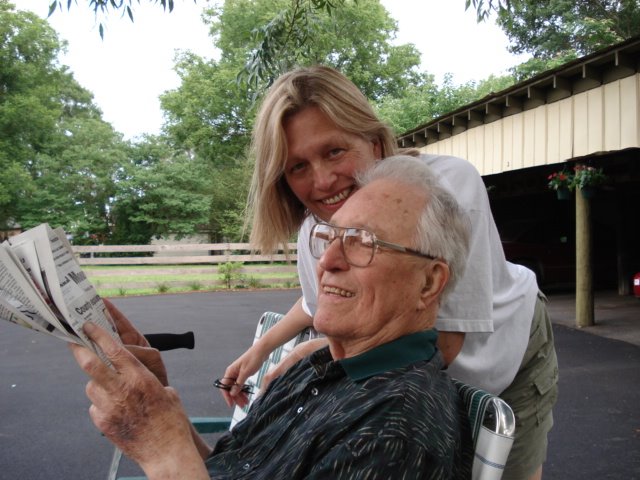
This is a recent picture of my father and me taken during my visit in Alabama. Below is a poem written in his honor and published in the inaugural issue of _Poemeleon_, an online journal of poetry edited by Cati Porter. Click on the above title "Blackbirds" to visit _Poemeleon_.
Blackbirds
Like a canopy of darkness
they shadow the ground for miles
on currents that lift them
back to their roosts.
Years later I ask my father
if he gathered us
to watch thousands
swoop down on trees
sit wing to wing
until morning branches cracked
under their weight.
At daybreak did they leave the oaks
bare?
He says we never saw them abandon the hollow
catch a new wind to an unharvested south
but often would pile into the car to see their return
black streaks on the upward drift
of a September afternoon.
Chella Courington
June 2006
Saturday, June 17, 2006
Visiting my dad in Rural Alabama

We spent three weeks with my dad in Albertville in North Alabama at the tip end of the Appalachians. The locals like to eat lunch at the Albertville Candy Store, a kind of general food/trinket store on Main Street. In the back the older ladies play bridge three times a week.

Here's a typical daily menu. BTW, the Candy Store serves lunch Monday through Friday. Come as you are.
Friday, June 09, 2006
wishes for sons
lucille clifton is one of my favorite poets. she speaks so honestly about being female.
wishes for sons
by Lucille Clifton
i wish them cramps.
i wish them a strange town
and the last tampon.
I wish them no 7-11.
i wish them one week early
and wearing a white skirt.
i wish them one week late.
later i wish them hot flashes
and clots like you
wouldn't believe. let the
flashes come when they
meet someone special.
let the clots come
when they want to.
let them think they have accepted
arrogance in the universe,
then bring them to gynecologists
not unlike themselves.
Copyright ©1991 by Lucille Clifton. Reprinted from Quilting: Poems 1987-1990 with the permission of BOA Editions, Ltd., 260 East Ave., Rochester, NY 14604. Poets.Org
Tuesday, June 06, 2006
Stephen Colbert Addresses Graduates at Knox College
It’s that wonderful time of year when students graduate from college & wonder: what now? Stephen Colbert, one of my faves, gave the commencement speech at Knox College, June 3. While the text can be accessed by clicking on the above hot link title, here’s an excerpt:
There are so many challenges facing this next generation, and as they said earlier, you are up for these challenges. And I agree, except that I don’t think you are. I don’t know if you’re tough enough to handle this. You are the most cuddled generation in history. I belong to the last generation that did not have to be in a car seat. You had to be in car seats. I did not have to wear a helmet when I rode my bike. You do. You have to wear helmets when you go swimming, right? In case you bump your head against the side of the pool. Oh, by the way, I should have said, my speech today may contain some peanut products.
My mother had 11 children: Jimmy, Eddie, Mary, Billy, Morgan, Tommy, Jay, Lou, Paul, Peter, Stephen. You may applaud my mother’s womb. Thank you, I’ll let her know. She could never protect us the way you all have been protected. She couldn’t fit 11 car seats. She would just open the back of her Town & Country—stack us like cord wood: four this way, four that way. And she put crushed glass in the empty spaces to keep it steady. Then she would roll up all the windows in the winter time and light up a cigarette. When I die I will not need to be embalmed, because as a child my mother hickory-smoked me.
Saturday, June 03, 2006
Return after Hiatus

I'm pleased to announce that Jim Bennett has added my blog to Poetry Kit, a central place for locating blogs on & about poetry. Since the first annual poetry contest, activity has been low with the end of school and my dad's fall. I'm glad to report that I am writing a fair amount, looking forward to more creative time when Ted & I return to Caifornia.
Monday, May 15, 2006
Winners of the Gravity & Light Poetry Contest
I want to thank the numerous poets who submitted poems for the first annual Gravity & Light Poetry Contest. All submissions demonstrated excellence. The judges, however, selected two poems as their favorites: “Administering My Dog’s Cancer Therapy, I Think About My Sons,” first place, by Cati Porter & “ Bermuda Grass in Lincoln Park,” second place, by Brandon K. Wallace. Both are published below.
Administering My Dog’s Cancer Therapy, I Think About My Sons
Cati Porter
My thumb and forefinger pinch a pill as I thrust my fist
back into his throat. His teeth, a bracelet of blunt
tines, rake gently over my wrist.
I pull out my hand sticky with his saliva
and hold his mouth closed
and stroke his neck
until I am certain he has swallowed.
At seven years old he is two years older than
my oldest son. He is my oldest son,
I tell myself, but of course, he is not.
He is just the dog, I remind myself daily,
because, if he were my son,
I would okay the endoscopy, biopsy
the lining of his stomach. I would make the drive
into the next county for intravenous chemotherapy.
Once he ate reluctantly from my hand chicken breasts
boiled for him on my stove. If he were
my son, I would not hand-feed him
the breasts of dead chickens. I would slice
off my own, boil them
pink to white in my very best pot.
I would shred them, feed them to him
warm, if only to keep him through the night.
XXXVIII
The 1980s
Bermuda Grass in Lincoln Park
Brandon K. Wallace
The sound of black musicians on guitar- Earth, Wind, and Fire combining the
elements in a gravitational groove, pulled into the dizzy of a neutron dance.
A lipstick, cherry bright as the light of a smile, red Thunderbird, the
blackenized Barbie turned inside out, pulled up into the alley, against the
crosspatch, metal fence behind the house with shaved top and delicate cement,
only the slightest bit of grass growing through the cracks where we played Red
Light/ Green Light Red Green Red and Green Lights flashing, blending together
in backgrounds of black and sunshine yellow, the red appears in pores and
freckles in the brightness of the sun with the distant green tops of trees, the
green of the electric carpet against which I used to rub to feel the current.
Rows of houses, claustrophobically close, creating closeness and warmth, Coca
Cola and Pepsi, in red bottles with white lines, sprite in green and lemon
yellow, juicy fruit and Ronald Reagan, Jesse Jackson in wool overcoats holding
signs, campaigns for change. Change.
Harold Washington, change, the color of his suits. Kinetic movement, promise
and vision.
Monday, April 17, 2006

TIKI by Andre Breton
TIKI
Je t'aime a la face des mers
Rouge comme l'oeuf quand il est vert
Tu me transportes dans une clairiere
Douce aux mains comme une caille
Tu m’appuies sur le ventre de la femme
Comme contre un olivier de nacre
Tu me donnes l”equilibre
Tu me couches
Par rapport au fait d’avoir vecu
Avant et après
Sous mes paupieres de caoutchouc.
Andre Breton
TRANSLATION: TIKI
I love you across the seas
Red as the egg when it is green
You move me into a clearing
Gentle with hands like a quail
You rest me against the woman’s belly
As against the mother-of-pearl olive tree
You give me balance
You put me to bed
By the fact of having lived
Before and after
Under my rubber eyelids.
Tuesday, April 11, 2006
The Devil’s Beatin’ His Wife by Chella Courington
“If you could choose, would you want it to rain all the time or shine all the time?”
I draw hopscotch squares on the concrete sidewalk in front of grandma’s house. Since my sister’s two years older, she always talks to me in questions, trying to trip me up and make her seem smarter. So I just throw questions back to let Julia know I’m smart too.
“Can I turn off the rain when I want to?”
“Nope, you gotta carry an umbrella. “
“Can I play in the rain on summer days when it’s so hot my hair’s all sweaty?”
“Yep, but only in the backyard and you gotta wear your swimsuit. No running naked like we do under the hose. “
“Can I tell the sun to go behind the clouds?”
“Nope, you can’t tell the sun to do anything. He’s bigger and stronger than anybody except God.”
“Can I ask the sun not to melt the snow?”
“Nope, you can’t ask the sun any questions. He has too much to do to fool with a dumb girl.”
“Well, smartie pants, I’d rather have rain and sun together to heat me up and cool me off at the same time.”
“Yeah, well that means the devil’s beatin’ his wife!”
“That means what? “ I yell, scratching a one and zero in the top square.
“You heard me. The devil’s beatin’ his wife.”
“I don’t believe you. The devil’s not married to begin with.”
“Yeah he is. They just never tell us about it in Sunday school. His wife looks just like my first-grade teacher. A long pointed nose with glasses and she smells like chicken poop. They say she fries bad girls in hot grease and then stuffs them in a barrel.”
“If he has a wife, why does he beat her?”
“Because the devil ‘s the meanest man in the world and beats up anybody he wants to just like the baddest boy in school. “
Ever since Halloween, Julia tries to scare me with stories of mean people who like to kidnap and torture kids. “You’re telling a fib,” I scream at her.
“If you don’t believe me, go ask grandma. “
So we leave the sidewalk and run into the house. Grandma’s in the kitchen, snapping beans at the sink and looking out the window at butterflies around the crepe myrtles. She knows things we don’t. She says flowers are named after girls who smell sweet and act sweet. That butterflies are the spirits of loved ones in heaven. “Grandma, does the devil have a wife?” I blurt out before Julia can open her mouth. Just because she’s older doesn’t make her smarter and she can’t scare me now with grandma near.
“Well, hon, I don’t know about that though I kinda doubt it. He’s way too mean and ornery for any woman to put up with, no matter how irritating she is.”
“What about Mr. Wells? You said he was mean as a snake. He has a wife.”
“Yeah, but he wasn’t always mean. Plus he was good-looking. A wife will forgive a heap of sins from a good-looking husband.”
“Do you think the devil ever looked good?”
“Absolutely never. I know it for a fact. But I’ve always heard tell that, if you see sunshine through rain, the devil’s beatin’ his wife. And who can argue with what my own grandmamma told me when I was your age. She always said ‘rain flickers like Christmas lights when it falls through God’s sunshine.’ Girls, go look out the back door! “
Raindrops sparkle in the sun. Behind them a yellow and red rainbow reaches from the sidewalk to the other side of the backyard, and I know my grandma is the smartest and sweetest person on earth and my sister will never be a flower!
Note: This children's story, based on a folk expression, first sppeared online in _Penwomanship_, linked in the header.
Wednesday, April 05, 2006
KGB Bar in NYC
Ted & I are in NYC, celebrating my March birthday belatedly and visiting one of my dearest friends, Lisa Williams, author of _Letters to Virginia Woolf_. Monday night we went to the KGB Bar in the Village to hear Kay Ryan read. She, of course, was wonderful with witty & intellectual work! The bar itself is an old workers bar: marble steps lead upstairs to a small room. A perfect way to enjoy National Poetry Month! BTW, remember to send in your poems for Gravity and Light's First Annual Poetry Contest. See previous posts for guidelines. Be well & keep writing.
Wednesday, March 29, 2006
POETRY CONTEST PROGRESS REPORT
I'm pleased to report that entries have started to roll in for the first Gravity & Light April Poetry Contest. Eminent local writers have agreed to read all poems in early May and announce the winner May 12.
Keep those poems coming! Good night and good luck.
Monday, March 27, 2006
APRIL POETRY CONTEST
Okay, here goes. Out of respect to April as National Poetry Month, this blog, known as Gravity and Light, will sponsor a month-long poetry contest. The expectations are few: no rhyming, no poem over 50 lines, fresh and surprising, concentrated and imagistic. Deadline: April 30. So, there we are. Please send entries in the text of an email to: couring@sbcc.edu Good luck and good writing! May the Muse bless our Olympics of Poetry! Best, C Courington
LET DARKNESS COME
Here's a piece written as a freewrite several years ago.
Let Darkness Come
The route to darkness meanders down through nightmares that entangle and cloud the light. Buried emotions attack the jugular vein, scream deadly slogans, tackle us when we least expect it. I had a friend who spent the last ten years of living, looking for outs to his clinically depressed existence. He tried suicide almost as many times as I tried new lovers from overdosing to carbon monoxide to slamming his Harley into the side of Compass Bank. I talked him back into life almost every time. He’d grin like a devil sick of sin: “Yeah, I’m crazy. You’re crazy. We all are.” He pulled me down on him. Then he’d walk into a dark room and begin the descent over and over and over again. I look back at those early mornings when he’d take me on his Harley around Monte Sano, a winding mountain road. And I remember the last time he called me at 4 a.m. Sunday. He said he was walking alone into the darkness and asked if I would join him. I was scared, knew he spoke a language I didn’t understand, and immediately drove over to his place—near county highway 9. When I got there, about fifteen minutes from my apartment, everything was dark. The door was cracked; I walked in. The silence was deafening. Nobody was there. I knew in my bones Jimmy was gone forever and drove home to sit by the phone until I heard something. His cousin called at 10—Jimmy shot himself in the head at Lake Guntersville near the state lodge. His body was slumped against a picnic table. I felt cold, my jaw locked, and I slammed down the phone.
Saturday, March 11, 2006
BLURBS ON _SOUTHERN GIRL GONE WRONG_
The following are the blurbs on my first chapbook entitled, _Southern Girl Gone Wrong_, published by Foothills Publishing of New York in fall 2004. When I returned to writing poetry in 2003 after almost a 20-year hiatus in the world of academic writing, Perie Longo was my mentor and guide, giving me the needed advice and encouragement to keep writing. My dear friend and colleague, David Starkey, is my model for seeking creative challenges and pushing myself to grow as a poet. His productivity inspires.
"No one writes of sexuality more sweetly or bitterly, when taken by even the most holy, than Chella Courington. Her poems sizzle under southern sun and make you want to go take a cold shower. Her talk is tough, sensual, sparse yet laced with lyricism and love for the family, in the end, and all things southern that come from staring truth in the face. Startling images are there not for effect, but rise out of suffering, and like her, we are 'saved' by memory's exquisite touch."
--Perie Longo
Author of The Privacy of Wind
"In Chella Courington's 'Jesus Loves Me' the speaker fantasizes about making love to Jesus. The experience she describes is both sinful yet oddly innocent, and that atmosphere of naiveté and abandon pervades the poems in_ Southern Girl Gone Wrong_. Courington's world is lush, humid, sensual and inviting: once you enter it, you'll want to stay."
--David Starkey
Author of Open Mike Night at the Cabaret Voltaire
and Fear of Everything
BTW, my chapbook can be purchased online at Foothills Publishing, linked to the right. Thanks for supporting poetry!
Thursday, March 09, 2006
SNAKE CHARMER
Jake tickles my cheek with his tongue, and I lean against
him. Sliding over my shoulder like the Virgin’s mantle,
he rolls his muscles to the drummer’s beat. A whore
mama calls me and says anybody in a strip joint sleeps
with the Devil. Her Jesus is about covered dish suppers
and long dresses. Mine’s not cooped up in the Boaz
Baptist Church drinking juice and eating saltines. He’s in
the clubs, witnessing to the night people. When the sax
man plays “Amazing Grace,” Jake curls around me. His
head sways from side to side, biting my lip before
the music fades, and everybody’s washed in light.
Chella Courington
Published in _Desert Voices_, (volume 4, issue 1) December 2005
Friday, February 24, 2006
Stories I Want to Tell
Peter all in blue
flies from Mr. McGregor
drops one shoe
in cabbage
another
in potatoes.
My hero
outwits this farmer
every garden turn.
Forfeits jacket
before slipping
under gate.
In my story
Peter finds me
outside with a pink suitcase.
But don’t mistake us
no Alice and Mad Hatter
no Grace and White Rabbit.
We are Chella and Peter
in a wood at dusk
far from family noise.
He tells me his grandfather
sacrificed his own tail
to save Otter.
I want to confess
my father shoots otter
bruises me
when mother’s not home.
I want to say
some pain is worse
than dying.
Peter holds my hand
under the harvest moon
stars floating downstream.
Chella Courington
Published in _Phantasmagoria_(volume 5, number 2)
Monday, February 20, 2006
Bush on Top
Bush is on top, and the grammar cops are out. No health care for the poor, no drug care for the elderly, no choice to the ladies. But sure as hell no comma splices, no run-on sentences. And fragments! Crucify Faulkner. Heaven forbid. Grammar matters. How else can we distinguish rote learners who believe in arbitrary standards from everybody else? Too many funny tongues out there not to detain them in rules. People speak Spanish and Arabic and German and Slavic. Grammar matters. Just look at those Appalachian folk, nestled in woods where banjos still duel. They speak the King’s English. All those double negatives of Shakespeare never went out of fashion. They maintained the standard. They don’t know no different. Hooray for Shakespeare! Give me my own tongue. 2006. Grammar books on The New York Times best-seller list. Check out the authors. Any of these books by persons of color? Who’s clamoring for the maintenance of the old guard? It just rubs me the wrong way when folks start bandying about rules of grammar. Sure (ly). Business letters need to be as clean of grammatical unconvention as possible. They’re directed to one of the most conservative elements in the United States of American: Business. An industry that works in cliché: judges everything by the cover. Not to sound like an anarchist but grammar is not organic: grammar is made by usage. So what if your English grandmother said “Give the cup to John and me” and you say “give it to John and I.” But like much in this predictable life, an emphasis on grammar in 2006 is not surprising. Grammar cops work in cahoots with Homeland Security.
Saturday, February 11, 2006
Writing in the Dirt
Daddy still doesn’t know me after forty years.
Thinks I ought to praise Jesus and live five miles away.
He reads a poem I wrote about a penis.
Throws his arm high like Moses with a staff.
Stomps out the back door
mumbling in his wake.
Later I hear him tell mama
"That girl of yours writes in the dirt."
I turn my face to the wall.
Cracks of plaster deepen
every time the house settles.
Red clay shifts to quicksand
swallows me whole.
My poem floats beyond the live oak.
This poem by Chella Courington was published in the recent issue of _In the Grove_.
Monday, January 23, 2006
My Turn to Watch Granddaddy's Body
He’d sit in a cane rocker on his dirt yard
shirt cuffs flapping yell to mama
girl bring me some tea.
Lucky for him she adored her daddy
otherwise that old goat
would’ve died a lot sooner.
A mining doctor he bled the sick
for money they never had called them
stupid animals.
When they couldn’t pay he bartered
for crops coal corn liquor
loved devil’s brew more than himself.
I thought some angry miner might
kill him with a bad batch instead
he died in his sleep at ninety.
I didn’t like him alive don’t care
what happens to him now but in respect
to all the dead I’ll stay my time.
Chella Courington
First appeared in _King Log_ and reprinted in _Southern Girl Gone Wrong_
Monday, January 09, 2006
Like branches of white ash, antlers
lie in spring snow in the foothills.
Close to me every year, he drops them
somewhere along the ravine.
March, I find them in tall grass
honeysuckle braided through tines.
Bees gather. Another season
his rack vibrates in red cedar
mobiles of bone clank till dawn.
I long for him to emerge
yet he never comes
leaving his musk before the fall.
Chella Courington
First Published in _NILAS_ (December 2005)
Thursday, January 05, 2006
ANTELOPE MEDICINE
Eyes full of moon
she studies me
behind the porch screen.
I smell of tobacco.
She of sage.
I breathe her in
feel my body bend to hers.
Over plains we race
spin through air
on legs lithe and strong
lifting into sky
until my lungs ache and
I fall back into sweet grass.
She covers me till morning.
Chella Courington
First Published in _NILAS_ (December 2005)
Monday, January 02, 2006
THE POULTRY PLANT
I spend long hours in this hot muggy room breaking the necks of chickens. Not with my hands like grandpa who swings the bird round till the neck pops. My machine chops off the head. Drops that blade and splatters blood every five seconds. Fresh blood that tastes salty and sweet at the same time. It bothered me at first. But the pay’s good. What I don’t like is the line chief. During break he tells me he knows when a girl has her period. He can smell her. Says he broke up with his last girlfriend cause she bled so much. He makes me feel dirty like I need to wash with lye. One day he follows me out to the car. Says he dreams about me. Likes to taste me in his sleep. Don’t tell him my dream. The one where he’s hanging with the chickens while I work my machine.
Chella Courington
First Published in the recent issue of _In the Grove_
Sunday, December 25, 2005
Merry Christmas!
Christmas would not be the same without remembering Charles Dickens and _A Christmas Carol_. I love the book with all its horror and rebirth, and I have two favorite film versions: the Alistair Sims treatment and the Muppets rendering. So, here are the last two paragraphs from ACC:
"Scrooge was better than his word. He did it all, and infinitely more; and to Tiny Tim, who did not die, he was a second father. He became as good a friend, as good a master, and as good a man, as the good old city knew, or any other good old city, town, or borough, in the good old world. Some people laughed to see the alteration in him, but he let them laugh, and little heeded them; for he was wise enough to know that nothing ever happened on this globe, for good, at which some people did not have their fill of laughter in the outset; and knowing that such as these would be blind anyway, he thought it quite as well that they should wrinkle up their eyes in grins, as have the malady in less attractive forms. His own heart laughed: and that was quite enough for him.
He had no further intercourse with Spirits, but lived upon the Total Abstinence Principle, ever afterwards; and it was always said of him, that he knew how to keep Christmas well, if any man alive possessed the knowledge. May that be truly said of us, and all of us! And so, as Tiny Tim observed, God Bless Us, Every One!"
Thursday, December 08, 2005
What lips my lips have kissed, and where, and why (Sonnet XLIII)
Edna St. Vincent Millay, born in 1892, was the first woman to receive the Pulitzer Prize for poetry, in 1923, for her fourth book of poetry. Millay's command of the sonnet was distinctive as she shaped her sonnets with powerful lyrical music and personal voice.
What lips my lips have kissed, and where, and why (Sonnet XLIII)
Edna St. Vincent Millay
What lips my lips have kissed, and where, and why,
I have forgotten, and what arms have lain
Under my head till morning; but the rain
Is full of ghosts tonight, that tap and sigh
Upon the glass and listen for reply,
And in my heart there stirs a quiet pain
For unremembered lads that not again
Will turn to me at midnight with a cry.
Thus in winter stands the lonely tree,
Nor knows what birds have vanished one by one,
Yet knows its boughs more silent than before:
I cannot say what loves have come and gone,
I only know that summer sang in me
A little while, that in me sings no more.
From _Collected Poems_ by Edna St. Vincent Millay, published by Harper & Brothers Publishers. Copyright © 1956 by Norma Millay Ellis.
Sunday, November 27, 2005
Being a Writer: Part II
7. If you met a young or new writer, is there any advice you would give her?
First, I’d say, Write. No matter where or what. Letters, journals, email, chat rooms. And read everything you can get your hands on from poetry and novels to newspapers and magazines. Second, believe in yourself and what you have to say. Every voice is unique and worth hearing. Third, be careful with whom you share your work. Try to be sure of your reader’s reliability as a safe reader. There are too many critics jealous of creators and hence undermine their work. Fourth, when you find safe and close readers, listen to their response. As it is important for the writer to have a developed voice, it is equally important for her to be open to solid criticism.
8. Every job has its ups and downs, things that are the best and worst of doing that job. What is, for you personally, the very best thing about what you do? The very worst?
The best thing about writing poetry is writing poetry: the imaginative journey and play with language. Once I realized that not every poem has to be “the best,” I started to have fun. The worst thing about writing poetry? If one chooses to publish, rejections can devastate a poet. My rule of thumb is to keep a number of poems circulating to journals so that rejection becomes part of acceptance. A very sort of Zen approach.
9. Was there a moment in your life when you knew for certain this was exactly what you wanted to do? If so, was it some pivotal person or event that you can tell our readers about?
My desire to write poetry has wavered between devotion and abandonment. But, as I mentioned somewhere above, my eighth grade teacher first hooked me on poetry. In later years Virginia Woolf and Dorothy Allison compelled me to want to write.
10. How do you think your writing, in general, impacts on today’s woman? Or does it? What about tomorrow’s woman?
I am committed to writing from my body, telling the shifting truths about sexuality and abuse from a female perspective. I’ve written several poems about going through puberty, a topic often ignored in poetry. I’m enchanted by the poetic power of words like “labia” and ‘vagina” and think it’s important for them to be heard aloud in poetry’s hallowed and respected domain. At readings, women my age and younger say that it’s empowering to hear work that addresses the female body in joy and grief.
11. Do you believe being a woman affects how you write? Explain.
Definitely. You can tell from my role models and my concerns with the female body that my voice is shaped by being female.
12. Have there been women in your life who challenged or altered the way you view(ed) yourself? Your work? Your world?
Oh, yes. You know my literary models—Woolf and Allison. Women from very different times and locations who share a love for writing from the body and depicting the woman-centered life. Other influences include my best friend’s mother, who was an unconventional thinker in a small, rural Southern town in the sixties. She taught me that reading and tolerance were key to a fuller life. Another woman with a strong impact was a colleague who showed me that the love for women awakens us to our potential as thinkers, creators, spiritualists and professionals.
13. If there were no boundaries of time, money, distance or anything else and you could spend one hour with any woman at all, whom would you choose and why?
I would choose to spend the time with Dorothy Allison. In her essays, novels, and poetry, she reflects knowledge, wit, wisdom, and understanding for the human condition plus she’s from the rural South and knows the deep ambivalence of such tangled roots of love and violence.
Friday, November 25, 2005
Being a Writer: Part I
A women's magazine interviewed me almost eighteen months ago about being a writer. While the interview never was published, I think it offers insight into my love for words. I will publish it here in two parts.
PART ONE
1. Could you tell us a little about yourself and what you write.
Raised on Sand Mountain at the Appalachian end in North Alabama, I grew up with a love-hate relationship to the place especially during the sixties. Family and friendships were warm and turbulent, loving and violent. If you weren’t a white, Christian, conventional heterosexual, you were a misfit, what many Southern folks called “funny.” My desire was to escape my birthplace, though not the South particularly, as I moved from Alabama to Georgia, Florida, and South Carolina and back to Alabama. In 2002 I finally migrated west with a partner and two cats and returned to writing poetry in May 2003. Much of the poetry in my chapbook, _Southern Girl Gone Wrong_, emerges from my past, examining the contradictions of family and relationship and recalling the Gothic strain that runs through Southern writing from William Faulkner to Dorothy Allison.
2. How long have you been writing? Have you always wanted to be a writer?
I remember first writing poetry in the eighth grade when Mrs. Smothers asked the class to write about a creepy experience. My poem talked about being caught outside in a lightening storm with nowhere to go. While she didn’t read it aloud as she did Mary’s, I was hooked and wrote poetry for about ten consecutive years sporadically.
3. Has what you write changed much since you first started? Tell us about some of the changes.
Oh, yes. Age and experience put me in a very different emotional and mental place for my poetry today. When much younger, I focused on angst, mostly mine, often in abstract language that I thought sounded impressive. While much of that anxiety still exists, I try to use concrete images and down-to-earth language to convey feelings. I’ve always loved how Marianne Moore describes poetry: “an imaginary garden full of real toads.”
4. When you were a very young girl, do you remember what you wanted to be? Would the woman she has become surprise that little girl? Why or why not?
Born in the fifties in a provincial area, my models were housewives defined by husbands. Early I rejected that role, knowing that I wanted to determine my identity on my own and thought I wanted to be a lawyer, working to rectify injustices. While in college, however, I determined that law wasn’t for me and veered toward writing. Maybe the poet/teacher I’ve become would surprise the girl with lawyerly hopes but not the girl who loved books and writing.
5. What is your educational background? Has your education had any impact on your writing, either positive or negative? Has it influenced what you write about? Has it made being published any easier?
With a Ph.D. in British and American literature from the University of South Carolina, I think it has had mixed effects with the balance being positive. I’ve read a wide range of good poetry and fiction that provides a deep sense of how words work and studied for a year under a wonderful teacher/poet, James Dickey. The negative effect is that, as a younger writer, I felt that if I couldn’t be great, I shouldn’t write. Consequently, I abandoned poetry for about twenty years and disavowed a significant part of who I am. When I returned to it in 2003, I felt as if I’d come home. Concerning the influence of my education on what I write, I think it has given me the confidence to feel comfortable with almost any topic or form I choose whether autobiography or politics, free verse or a pantoum. While I think that a Ph.D. has not made it easier to publish poetry, I do think that the academic habit of sending out articles for publication gave me a certain kind of work ethic that makes me more aggressive toward publication, researching journals and sending out work on a regular basis.
6. Have you always wanted to be a published author?
In my early twenties, I wasn’t as keen about being published as I currently am though now, as then, I mostly enjoy the process of writing poetry and where it goes imaginatively. For me the most pleasurable publication is sharing work with friends and in readings, and I’m pleased that I’ve had several readings since returning to poetry. But I’m also pleased to see my work in journals as one kind of professional validation.
Thursday, November 24, 2005
Memories
During the summer, I was gung-ho about my blog. I remember how excited I was to be linked at other blogs and still am. But September came and school started with classes to attend to. And I do love teaching. In the process, however, I've neglected Gravity and Light, stepping in now and then to post a poem and say I'm here. I have no holiday poem though I shall post a poem written about two years ago in honor of my father and recalls a time when my experience was still fairly unmarked by life's passing. So I dedicate "Blackbirds" to our memories.
BLACKBIRDS
Like a canopy of darkness
they shadow the ground for miles
on currents that lift them
back to their roosts.
Years later I ask my father
if he gathered us
to watch thousands
swoop down on trees
sit wing to wing
until morning branches cracked
under their weight.
At daybreak did they leave the oaks
bare?
He says we never saw them abandon the hollow
catch a new wind to an unharvested south
but often would pile into the car to see their return
black streaks on the upward drift
of a September afternoon.
Friday, October 28, 2005
Hello Again
After almost a month of hiding, I'm back! Here's a recent poem featured in _iris_ online.
JANE EYRE TAKES TO CYBERSPACE
Tired of midnight screams in drafty rooms
she imagines a jaunt down lover’s lane
like a walk on the moors
to distract her dampened spirits
if she can make it on match.com
through questions
more questions than any governess agency
dares to ask.
She wants to speak the truth
though truth often brings her trouble.
So this time she’ll slip
into white lies.
Plain? Not Very
Exciting? Somewhat
Sexy?Very
Lying is fun.
She can turn herself into a babe
by clicking keys.
Who cares if Rochester waits for her
the other side of a burning house.
She’s sick of gloom
of being the model for every wallflower
in every century.
Longs to be a hot young star
even Barbie would emulate.
To shine in cyberspace.
Sunday, October 02, 2005
A Love Poem by Emily Dickinson
Wild nights! Wild nights!
Were I with thee,
Wild nights should be
Our luxury!
Futile the winds 5
To a heart in port,—
Done with the compass,
Done with the chart.
Rowing in Eden!
Ah! the sea! 10
Might I but moor
To-night in thee!
Wednesday, September 28, 2005
Like A Rolling Stone
Dylan's lyrics live on and on. Wish we poets could write with his clarity!
Once upon a time you dressed so fine
You threw the bums a dime in your prime, didn't you?
People'd call, say, "Beware doll, you're bound to fall"
You thought they were all kiddin' you
You used to laugh about
Everybody that was hangin' out
Now you don't talk so loud
Now you don't seem so proud
About having to be scrounging for your next meal.
How does it feel
How does it feel
To be without a home
Like a complete unknown
Like a rolling stone?
You've gone to the finest school all right, Miss Lonely
But you know you only used to get juiced in it
And nobody has ever taught you how to live on the street
And now you find out you're gonna have to get used to it
You said you'd never compromise
With the mystery tramp, but now you realize
He's not selling any alibis
As you stare into the vacuum of his eyes
And ask him do you want to make a deal?
How does it feel
How does it feel
To be on your own
With no direction home
Like a complete unknown
Like a rolling stone?
You never turned around to see the frowns on the jugglers and the clowns
When they all come down and did tricks for you
You never understood that it ain't no good
You shouldn't let other people get your kicks for you
You used to ride on the chrome horse with your diplomat
Who carried on his shoulder a Siamese cat
Ain't it hard when you discover that
He really wasn't where it's at
After he took from you everything he could steal.
How does it feel
How does it feel
To be on your own
With no direction home
Like a complete unknown
Like a rolling stone?
Princess on the steeple and all the pretty people
They're drinkin', thinkin' that they got it made
Exchanging all kinds of precious gifts and things
But you'd better lift your diamond ring, you'd better pawn it babe
You used to be so amused
At Napoleon in rags and the language that he used
Go to him now, he calls you, you can't refuse
When you got nothing, you got nothing to lose
You're invisible now, you got no secrets to conceal.
How does it feel
How does it feel
To be on your own
With no direction home
Like a complete unknown
Like a rolling stone?
Monday, September 26, 2005
Headstones
Mama says headstones quiet the spirit
give it place in a fickle world.
I don’t believe her so she drags
me to the cemetery and sobs
for my soul over her papa’s grave.
She tends to the sick and teaches
Sunday school until the doctor
finds a lump. Mama turns her face
from him in tears. "Why me Lord?"
I bury her close to her parents
near mimosa, shading marble
embossed with her likeness.
Years later I visit Emerson’s tomb
granite larger than a kitchen table.
Even this transcendentalist
stakes a claim to a piece of earth.
Chella Courington, from _Southern Girl Gone Wrong_, Foothills Publishing
Saturday, September 17, 2005
CD Wright
born and raised in arkansas and now teaching at brown university, cd wright's poetry rings with clarity and honesty.
Personals
Some nights I sleep with my dress on. My teeth
are small and even. I don't get headaches.
Since 1971 or before, I have hunted a bench
where I could eat my pimento cheese in peace.
If this were Tennessee and across that river, Arkansas,
I'd meet you in West Memphis tonight. We could
have a big time. Danger, shoulder soft.
Do not lie or lean on me. I'm still trying to find a job
for which a simple machine isn't better suited.
I've seen people die of money. Look at Admiral Benbow. I wish
like certain fishes, we came equipped with light organs.
Which reminds me of a little known fact:
if we were going the speed of light, this dome
would be shrinking while we were gaining weight.
Isn't the road crooked and steep.
In this humidity, I make repairs by night. I'm not one
among millions who saw Monroe's face
in the moon. I go blank looking at that face.
If I could afford it I'd live in hotels. I won awards
in spelling and the Australian crawl. Long long ago.
Grandmother married a man named Ivan. The men called him
Eve. Stranger, to tell the truth, in dog years I am up there
Linked at The American Academy of Poets
Tuesday, September 13, 2005
Passage
Annie finds a dead hawk, drops it in her backpack
knows the spirit is near since the body’s still warm
raises her arms like a winged warrior
ready to migrate with the untethered
and takes off to her house where
she preserves the bird’s remains
as carefully as any shaman.
Washes him bone by bone
chants how the spirit hovers seven days
till the body is set for the next journey
douses the quills in alcohol
stores his down in a cedar box.
Chella Courington _Southern Girl Gone Wrong_, Foothills Publishing, 2004.
Sunday, September 11, 2005
Remembering 9/11
in honor of the lives saved and lost, of those who gave of themselves tirelessly, of the heartache and courage we endure,
here's a poem by deborah garrison that first appeared in _the new yorker_, 22 oct., 2001:
I Saw You Walking
I saw you walking through Newark Penn Station
in your shoes of white ash. At the corner
of my nervous glance your dazed passage
first forced me away, tracing the crescent
berth you'd give a drunk, a lurcher, nuzzling
all corners with ill will and his stench, but
not this one, not today; one shirt arm's sheared
clean from the shoulder, the whole bare limb
wet with muscle and shining dimly pink,
the other full-sheathed in cotton, Brooks Bros.
type, the cuff yet buttoned at the wrist, a
parody of careful dress, preparedness --
so you had not rolled up your sleeves yet this
morning when your suit jacket (here are
the pants, dark gray, with subtle stripe, as worn
by men like you on ordinary days)
and briefcase (you've none, reverse commuter
come from the pit with nothing to carry
but your life) were torn from you, as your life
was not. Your face itself seemed to be walking,
leading your body north, though the age
of the face, blank and ashen, passing forth
and away from me, was unclear, the sandy
crown of hair powdered white like your feet, but
underneath not yet gray -- forty-seven?
forty-eight? The age of someone's father --
and I trembled for your luck, for your broad,
dusted back, half shirted, walking away;
I should have dropped to my knees to thank God
you were alive, o my God, in whom I don't believe.
--Deborah Garrison. The New Yorker, 22 October 2001. Reprinted in 110 Stories: New York Writes After September 11,edited by Ulrich Baer. New York University Press. 2002.
Friday, September 09, 2005
love nola like one of my own
having grown up in the south and later taught in montgomery, al, for almost 15 years, i spent a lot of time in new orleans. i remember my first plane trip was from new orleans to birmingham, after taking the train to tulane for the weekend. when my dad turned eighty, my bro and i asked how he wanted to celebrate: take a train to new orleans and do some fine eating. every spring, i travelled there for the tennessee williams festival and stayed in apartments across from le petit theatre near jackson square. i ventured there for the jazz festival, seeing baez and osburne and the indigo girls in one concert. and i travelled there many other times for the joy of being surrounded by sounds and music and landscape and architecture and people i love. in honor of that beloved city, here's a langston huges poem:
The Negro Speaks of Rivers
I've known rivers:
I've known rivers ancient as the world and older than the
flow of human blood in human veins.
My soul has grown deep like the rivers.
I bathed in the Euphrates when dawns were young.
I built my hut near the Congo and it lulled me to sleep.
I looked upon the Nile and raised the pyramids above it.
I heard the singing of the Mississippi when Abe Lincoln
went down to New Orleans, and I've seen its muddy
bosom turn all golden in the sunset.
I've known rivers:
Ancient, dusky rivers.
My soul has grown deep like the rivers.
From _The Collected Poems of Langston Hughes_, published by Alfred A. Knopf, Inc. Copyright © 1994 the Estate of Langston Hughes. Linked at The Academy of American Poets.
Saturday, September 03, 2005
honoring gulf coast evacuees: a poem by lucille clifton
the mississippi river empties into the gulf
and the gulf enters the sea and so forth,
none of them emptying anything,
all of them carrying yesterday
forever on their white tipped backs,
all of them dragging forward tomorrow.
it is the great circulation
of the earth's body, like the blood
of the gods, this river in which the past
is always flowing. every water
is the same water coming round.
everyday someone is standing on the edge
of this river, staring into time,
whispering mistakenly:
only here. only now.
lucille clifton
linked from Modern American Poetry: http://www.english.uiuc.edu/maps/poets/a_f/clifton/onlinepoems.htm
Friday, September 02, 2005
overwhelming sadness in new orleans
living on the west coast and seeing at a distance what has happened to our beloved new orleans is heartbreaking! our deserted brothers and sisters need our financial and physical help now. once lives are saved and people rescued, then we can look to the source of the problem.
in honor of those in louisiana, alabama and mississippi and other deserted peoples:
Let America Be America Again
by Langston Hughes
Let America be America again.
Let it be the dream it used to be.
Let it be the pioneer on the plain
Seeking a home where he himself is free.
(America never was America to me.)
Let America be the dream the dreamers dreamed--
Let it be that great strong land of love
Where never kings connive nor tyrants scheme
That any man be crushed by one above.
(It never was America to me.)
O, let my land be a land where Liberty
Is crowned with no false patriotic wreath,
But opportunity is real, and life is free,
Equality is in the air we breathe.
(There's never been equality for me,
Nor freedom in this "homeland of the free.")
Say, who are you that mumbles in the dark?
And who are you that draws your veil across the stars?
I am the poor white, fooled and pushed apart,
I am the Negro bearing slavery's scars.
I am the red man driven from the land,
I am the immigrant clutching the hope I seek--
And finding only the same old stupid plan
Of dog eat dog, of mighty crush the weak.
I am the young man, full of strength and hope,
Tangled in that ancient endless chain
Of profit, power, gain, of grab the land!
Of grab the gold! Of grab the ways of satisfying need!
Of work the men! Of take the pay!
Of owning everything for one's own greed!
I am the farmer, bondsman to the soil.
I am the worker sold to the machine.
I am the Negro, servant to you all.
I am the people, humble, hungry, mean--
Hungry yet today despite the dream.
Beaten yet today--O, Pioneers!
I am the man who never got ahead,
The poorest worker bartered through the years.
Yet I'm the one who dreamt our basic dream
In the Old World while still a serf of kings,
Who dreamt a dream so strong, so brave, so true,
That even yet its mighty daring sings
In every brick and stone, in every furrow turned
That's made America the land it has become.
O, I'm the man who sailed those early seas
In search of what I meant to be my home--
For I'm the one who left dark Ireland's shore,
And Poland's plain, and England's grassy lea,
And torn from Black Africa's strand I came
To build a "homeland of the free."
The free?
Who said the free? Not me?
Surely not me? The millions on relief today?
The millions shot down when we strike?
The millions who have nothing for our pay?
For all the dreams we've dreamed
And all the songs we've sung
And all the hopes we've held
And all the flags we've hung,
The millions who have nothing for our pay--
Except the dream that's almost dead today.
O, let America be America again--
The land that never has been yet--
And yet must be--the land where every man is free.
The land that's mine--the poor man's, Indian's, Negro's, ME--
Who made America,
Whose sweat and blood, whose faith and pain,
Whose hand at the foundry, whose plow in the rain,
Must bring back our mighty dream again.
Sure, call me any ugly name you choose--
The steel of freedom does not stain.
From those who live like leeches on the people's lives,
We must take back our land again,
America!
O, yes,
I say it plain,
America never was America to me,
And yet I swear this oath--
America will be!
Out of the rack and ruin of our gangster death,
The rape and rot of graft, and stealth, and lies,
We, the people, must redeem
The land, the mines, the plants, the rivers.
The mountains and the endless plain--
All, all the stretch of these great green states--
And make America again!
From _The Collected Poems of Langston Hughes_, published by Alfred A. Knopf, Inc. Copyright © 1994 the Estate of Langston Hughes. Linked from The Academy of American Poets: http://www.poets.org/viewmedia.php/prmMID/15609
Subscribe to:
Posts (Atom)
